English
 日本語
日本語 Deutsch
 한국어
한국어 العربية
 Русский
 Türkçe
 Português
 Français
Cosmetic Glass Bottle Defects: A Practical QC Guide for Beauty Packaging Buyers
A beauty packaging buyer may start a project with a simple request:
“We want zero defects.”
The intention is easy to understand. Premium skincare, fragrance and makeup packaging needs to look clean, consistent and well made.
In production, quality management needs more precise language.
Glass containers are formed through high temperature manufacturing processes, and commercial production can show different types of visual or dimensional variation. More importantly, two marks that look similar at first glance may carry very different implications depending on where they appear and what type of defect they actually are.
A surface mark on a low visibility area is one situation.
A chipped bottle finish that may affect a sealing interface is another.
For procurement and quality teams, the more useful questions are:
What is the defect? Where is it located? How severe is it? What function could it affect?
CETIE provides dedicated technical resources for perfume and cosmetic glass packaging. Its DT26.10 glossary covers visual critical defects for cosmetics and perfumes and makes clear that specific requirements agreed between customer and supplier still apply. CETIE
This article shares general industry observations for buyer reference only. It does not constitute a legal, regulatory or contractual quality specification. Project specific acceptance criteria should be mutually agreed and documented between buyer and supplier before mass production, while applicable safety and regulatory requirements remain governing.
This distinction is important.
The purpose of this article is not to decide whether one particular bottle should pass or fail inspection. It provides a practical framework for discussing cosmetic glass bottle defects with suppliers, inspection teams and internal quality departments.
The focus is defect classification, defect location, reference samples, inspection records and pre production alignment.
Core Framework: Critical / Major / Minor General Concept
Many packaging quality plans organize defects into categories such as critical, major and minor.
These terms are useful because they help teams separate safety and functional concerns from appearance related variation. Their exact definitions and acceptance levels, however, remain project specific.
CETIE DT26.10 provides a dedicated defect reference for cosmetic and perfume glass containers while preserving the role of specifications agreed between customers and suppliers. It should therefore be used as technical guidance rather than treated as a universal acceptance table for every brand. CETIE
In general quality discussions:
Critical defects may refer to conditions with potential implications for consumer safety, sealing or the fundamental function of the package.
Major defects may refer to conditions that materially influence assembly, normal use, an important performance requirement or a significant part of the agreed appearance standard.
Minor defects often relate primarily to cosmetic appearance and usually carry less influence on normal package function.
These descriptions provide a useful communication framework. They do not automatically determine shipment disposition.
A luxury clear perfume bottle may have tighter visual expectations than an opaque coated bottle. A bottle using a sealing surface close to a particular glass feature may require additional attention in that area.
Decoration, closure design, bottle geometry and brand positioning can all influence the final specification.
That is why effective glass bottle defect classification starts with project requirements rather than a generic pass or fail table.
Real World Defect Observations and Why Location Matters
Location can change the significance of a defect considerably.
It should still be considered together with defect type, severity, sharpness, structural significance and the function of the affected area.
Chips
A chip involves loss of glass material.
The bottle finish deserves particular attention because this area often interacts directly with the closure, pump, gasket or sealing surface.
A chip around the finish, thread or sealing area may interfere with component engagement or sealing contact. Where fractured material is unstable, it may also create a loose glass particle concern.
CETIE's cosmetics and perfume defect resources specifically include chipped finish and identify it as a potential critical defect. CETIE
This explains why many projects apply tighter quality criteria around the finish.
The bottle body needs a more careful distinction.
A superficial blemish, rub mark or small surface imperfection may primarily influence appearance. An actual glass chip should still be evaluated for location, depth, sharpness, associated cracking and possible structural significance.
It should not automatically be classified as a minor cosmetic issue simply because it appears on the sidewall.
The heel and bottom edge also deserve attention.
These areas experience contact during handling, packing and transportation. Damage here may create a sharp edge or become more relevant when the container receives an impact.
The correct inspection question is therefore broader than:
“Is there a chip?”
A stronger question is:
Where is the chip, what condition surrounds it and what could that location affect?
Cracks
Correct identification is especially important when evaluating cracks.
A genuine crack or check is different from a superficial scratch, mould seam or decoration mark.
A structural crack represents a discontinuity in the glass and generally raises a much greater quality concern than an appearance mark.
Location adds another layer.
Fine cracking around the neck, finish or another functional area deserves careful examination because these areas may experience loads during assembly or closure application.
CETIE organizes glass defect information partly according to container location, including finish, neck, shoulder, body and bottom areas. This location based approach reflects the practical importance of understanding where a glass condition occurs. CETIE
When a fine line is discovered on a transparent bottle, classification should come before disposition.
Lighting and glass reflection can make a superficial scratch and a deeper glass feature look similar in a photograph. Additional physical examination may therefore be useful when the nature of the mark is uncertain.
For buyers, the main lesson is simple:
Identify the defect before assigning the risk category.
Bubbles
Bubbles are familiar features in glass quality discussions.
Their meaning depends on their location, form and the surrounding glass condition.
A small, fully enclosed bubble within the glass body may be treated mainly as an appearance consideration when it falls within the agreed specification and shows no associated structural concern.
A feature close to a sealing area or another functionally important location deserves closer evaluation.
The same applies when the bubble appears open to a surface, is associated with irregular glass distribution or occurs in a location that matters to the package design.
Brand expectations also influence the appearance standard.
A highly transparent premium perfume bottle may reveal internal glass features very clearly. A frosted or coated package creates a different visual environment.
This is why the phrase “bubble defect” alone provides too little information for a useful supplier discussion.
The specification should consider location, visibility, character and the agreed acceptance level.
nclusions and Foreign Particles
Dark points or embedded materials require careful identification as well.
A visible black point may represent an inclusion inside the glass, surface contamination, decoration material or another feature.
Its location matters, but so does its physical nature.
An inclusion close to an internal surface may deserve additional attention if it appears exposed or associated with damaged glass. A fully embedded inclusion cannot automatically be treated as an appearance issue either.
CETIE's impact testing guidance specifically refers to inclusions as possible stress concentrators that can reduce glass container impact resistance. CETIE
This is an important consideration for packaging buyers.
An embedded inclusion may meet the visual requirements of one project while still deserving structural assessment depending on its character, size and location.
This is why the phrase “foreign particle” should ideally be supported by a clear photo, physical inspection and agreed classification.
Decoration Deviations
Decoration introduces a different category of packaging quality issues.
Silk screen printing, hot stamping, spray coating, frosting and other surface processes each have their own visual characteristics.
A visibly misaligned logo on the primary display panel can have a strong effect on product presentation.
The same applies to missing hot stamping, obvious print registration issues or coating problems on the main visible surface.
A smaller variation on the bottle bottom or another low visibility area may carry a different commercial impact.
Yet location alone should not decide acceptance.
Decoration should be evaluated against approved artwork, agreed samples, viewing conditions and the documented quality specification.
For certain finished surfaces, adhesion and resistance may also need their own agreed evaluation methods rather than relying only on a visual check.
Across all of these examples, one principle remains useful:
Location strongly influences risk perception, while final judgment should follow the agreed project standard.
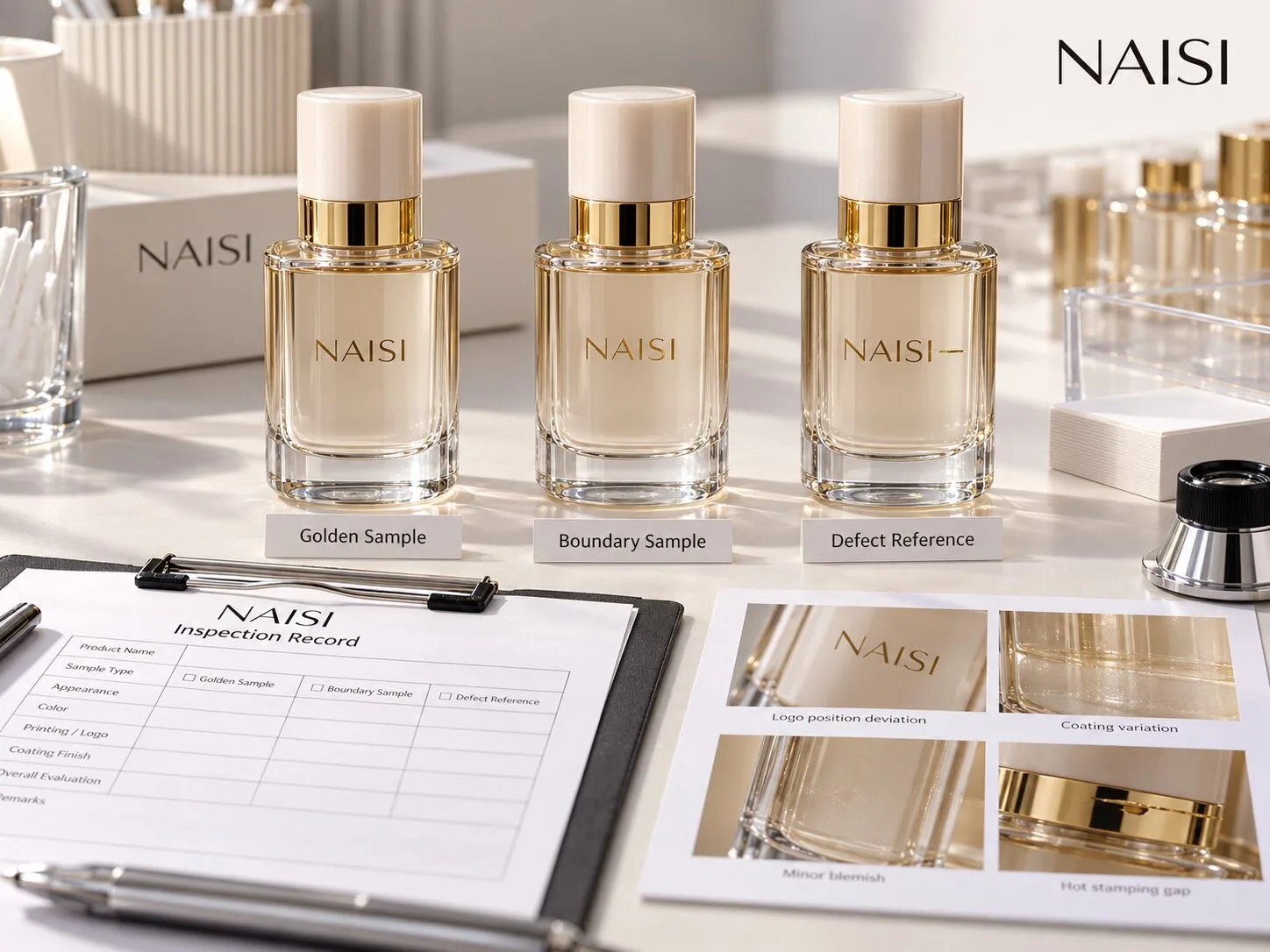
Practical QC Toolkit Suggestions for Buyers
Clear reference tools make cosmetic glass bottle inspection easier for buyers, suppliers and independent inspection teams.
They help turn subjective comments such as “this looks bad” into a shared quality language.
Golden Sample
An approved physical sample provides an important visual and dimensional reference.
For projects with demanding appearance standards, a practical reference set may include:
an approved golden sample, mutually agreed boundary samples and documented defect reference samples.
The golden sample represents an approved target.
A boundary sample shows a condition close to the agreed acceptance limit. This can be particularly useful because borderline cases often create the most discussion during bulk inspection.
A defect reference sample can illustrate a known unacceptable condition for that particular project.
Boundary samples should be mutually confirmed by buyer and supplier and supported by written records.
A physical sample also has limits.
One bottle cannot represent every possible production variation. The golden sample should therefore complement the written specification rather than replace dimensional tolerances, inspection criteria or other documented requirements.
Defect Reference Photos
A shared defect photo library can improve communication considerably.
Photos can record:
the defect type, its location, the relevant production lot and the classification agreed for that project.
Consistent lighting helps make comparisons more useful.
When size is relevant, an appropriate scale reference may also help.
The goal is not to create a universal defect catalogue for every future product. It is to reduce ambiguity within the specific project.
This becomes particularly valuable when a brand manages several SKUs, suppliers or inspection teams.
Acceptance Records
Inspection decisions should remain traceable.
A useful record may include the lot identification, inspection date, defect description, location, photographs and final disposition.
This creates continuity when a similar question appears during a later production run.
It can also help buyer and supplier distinguish an isolated discussion from an agreed precedent.
These tools represent useful industry practices. They are not mandatory procedures for every cosmetic packaging order.
Pre Production Alignment Checklist
The most productive time to discuss cosmetic glass bottle defects is before mass production begins.
Buyer and supplier can first agree on how important defect categories will be described.
Particular attention can then be given to functional areas such as the neck finish, sealing surface and other locations identified as significant for the project.
Signed physical references should be prepared where useful.
For appearance sensitive projects, viewing conditions are also worth discussing. Transparent glass, metallic decoration, spray coating and frosting can appear different under changing light.
A repeatable viewing environment can make inspection decisions more consistent.
The sampling approach should also be documented.
Some buyers use acceptance sampling systems based on ISO 2859 1. The current ISO 2859 1:2026 defines AQL indexed sampling schemes for lot by lot inspection by attributes and replaced the previous 1999 edition. ISO
AQL should be understood correctly.
It is a sampling framework rather than a universal cosmetic glass quality standard. The selected inspection level, AQL values, defect categories and acceptance rules should be agreed for the specific commercial project.
They should not simply be copied from another brand or another packaging format.
The two parties should also discuss how borderline findings will be handled during production.
This may include additional review, sorting, further inspection or another agreed disposition process.
The most important step is documentation.
Acceptance criteria should appear in the order specification, quality agreement or inspection documentation rather than relying on blog articles, informal messages or verbal understanding.
Quick Decision Reference for Shipment
When inspection identifies a defect with possible implications for consumer safety, sealing or glass integrity, early communication between buyer and supplier becomes important.
The affected products can be identified and segregated where appropriate so the finding remains traceable.
The team can then review:
the defect type, location, severity, relevant reference sample and the written specification.
Where classification remains uncertain, additional technical review or inspection may be appropriate.
Depending on the agreed quality specification, applicable safety requirements and commercial terms, the next step may involve additional inspection, sorting, concession review, shipment hold or lot rejection.
A concession should only be considered where the relevant requirements permit it.
Safety and regulatory obligations remain governing.
This approach gives both sides a clearer decision framework.
The buyer receives a result based on documented requirements. The supplier can respond to a specific technical finding rather than a subjective interpretation created after production.
Conclusion
Effective glass quality management is not about treating every visible variation as the same type of defect.
It is about identifying which characteristics affect safety, package function and appearance, then agreeing clear acceptance criteria before production.
A chip around the finish deserves a different discussion from a superficial body blemish.
A crack needs to be distinguished from a scratch.
A bubble should be evaluated according to its character and location. An embedded inclusion may also deserve structural consideration depending on its size, nature and position.
The useful framework is:
defect type, location, severity, function and agreed specification.
Together, these five factors give procurement and quality teams a much stronger basis for glass packaging quality control.
Physical reference samples add clarity.
Written specifications create consistency. Inspection records provide traceability when similar questions appear during later production.
CETIE's cosmetics and perfume glass resources reinforce this project specific approach by providing defect guidance while preserving requirements agreed between customers and suppliers. CETIE
This article offers general industry information only. It is not a legal, regulatory or contractual quality standard. Final acceptance criteria should be documented and mutually agreed for each project, subject to applicable safety and regulatory requirements.
At NAISI Packaging, we support stock and custom cosmetic glass bottle projects for skincare, fragrance and makeup packaging, together with decoration, sampling and production quality coordination.
If you are developing a new cosmetic glass package, defining quality expectations before bulk production can make inspection, supplier communication and shipment approval much clearer.
Explore our cosmetic glass bottle collection
Discuss your project requirements with our team