Français
 English
 日本語
日本語 Deutsch
 한국어
한국어 العربية
 Русский
 Türkçe
 Português

What Makes a Perfume Bottle Truly Refillable? Screw Necks, Pumps and Component Separation
Refillable fragrance packaging has moved from a design concept into a practical packaging engineering decision.
Regulation (EU) 2025/40, the EU Packaging and Packaging Waste Regulation, now applies across the European Union. It places stronger emphasis on recyclability, packaging minimisation, reuse and refill, while defining refill and reusable packaging as distinct concepts.
At the same time, fragrance component suppliers are developing screw necks, removable dispensing systems and refill connectors specifically around these new packaging architectures.
For fragrance brands, the practical question is simple:
How will the consumer refill the bottle, and will the complete package continue to function afterward?
The answer depends on more than the glass container.
Neck finish, pump fixation, sealing, refill method and end of life design all need to work together.
What “Truly Refillable” Actually Means (not just marketing)
A functional refill system begins with repeated access to the product container.
The consumer may unscrew the dispensing assembly, connect a refill device or use another refill mechanism designed around the package. After refilling, the bottle still needs to close securely and deliver fragrance as intended.
This makes refillability a system characteristic.
The PPWR defines refill as an operation in which a container performing the packaging function is filled again by the end user or final distributor. Reusable packaging is a separate regulatory concept and must satisfy additional conditions, including being designed for multiple rotations and maintaining safety and functionality through refilling and reuse.
For perfume development, this distinction matters.
A bottle marketed around a refill concept should have a clear technical refill route. The neck, dispensing assembly and sealing interface should support that route from the beginning.
Ease of use also matters.
The refill gesture should be practical for the intended consumer and consistent with the selected refill format.
#1 Critical Factor: Screw Neck Design for Refillable Perfume Bottles
Traditional fine fragrance bottles commonly use FEA crimp finishes.
With a crimp system, an aluminium ferrule is mechanically secured around the glass neck using dedicated crimping equipment. CETIE publishes technical recommendations specifically for this type of fragrance pump assembly.
This structure is well established for conventional fragrance packaging.
For a consumer refill system that requires opening the main bottle, a screw neck provides a different architecture.
CETIE's sustainable neck finish specifications include screw neck designs for perfume and cosmetic glass bottles. Its GME40.20 covers screw necks without an additional bead, while GME40.25 covers an interchangeable screw neck with an additional bead.
The SNI15 designation means Screw Neck International diameter 15.
The interchangeable version is particularly useful for packaging development. CETIE states that it can support mould interchangeability between crimp and screw versions and can help retain selected components such as collars and caps when moving from a crimp finish to a screw finish.
For buyers, this means the neck finish should be selected together with the dispensing system.
A screw neck creates access for refilling, but the complete perfume refill system still depends on the pump ferrule, sealing interface and surrounding components.
#2: Pump Selection, The Most Overlooked Refillable Component
The pump deserves the same attention as the bottle.
A conventional crimp fragrance pump is designed around permanent mechanical fixation. A screw on fragrance pump can provide repeated removal and reattachment when it has been engineered for that use.
Aptar Beauty provides a clear commercial example.
Its Essencia Screw uses an SNI15 screw on neck finish and is designed for consumer refilling. Aptar specifically states that the screw top can be reused multiple times.
Its Refill INUNE range also offers SNI15 screw on options for refillable prestige fragrance packaging.
This is why pump selection should take place early in bottle development.
The buyer should confirm fixation, neck finish, dosage, spray characteristics and component compatibility before approving the final glass neck.
A current 2026 industry example also shows that refill systems can go beyond simple unscrewing.
BVLGARI's Tygar Travel Spray uses Aptar Beauty's Nomad Refill platform. The 10 ml refillable glass vial uses an integrated refill connector compatible with full size bottles equipped with SNI15 screw on systems.
That example illustrates an important point.
The refill method itself is part of the packaging design.
For sampling, test the complete gesture. Open or connect the system, refill the bottle, close it again and confirm spray performance and sealing afterward.
#3 Component Separation and PPWR Recyclability
Component separation can support recycling oriented packaging design, but it should not be presented as a universal PPWR requirement that every consumer must manually dismantle every package.
The PPWR requires packaging to be recyclable and introduces design for recycling criteria. It also defines both integrated components and separate components, recognising that different packaging architectures may follow different recycling routes.
For fragrance packaging, the practical question is therefore:
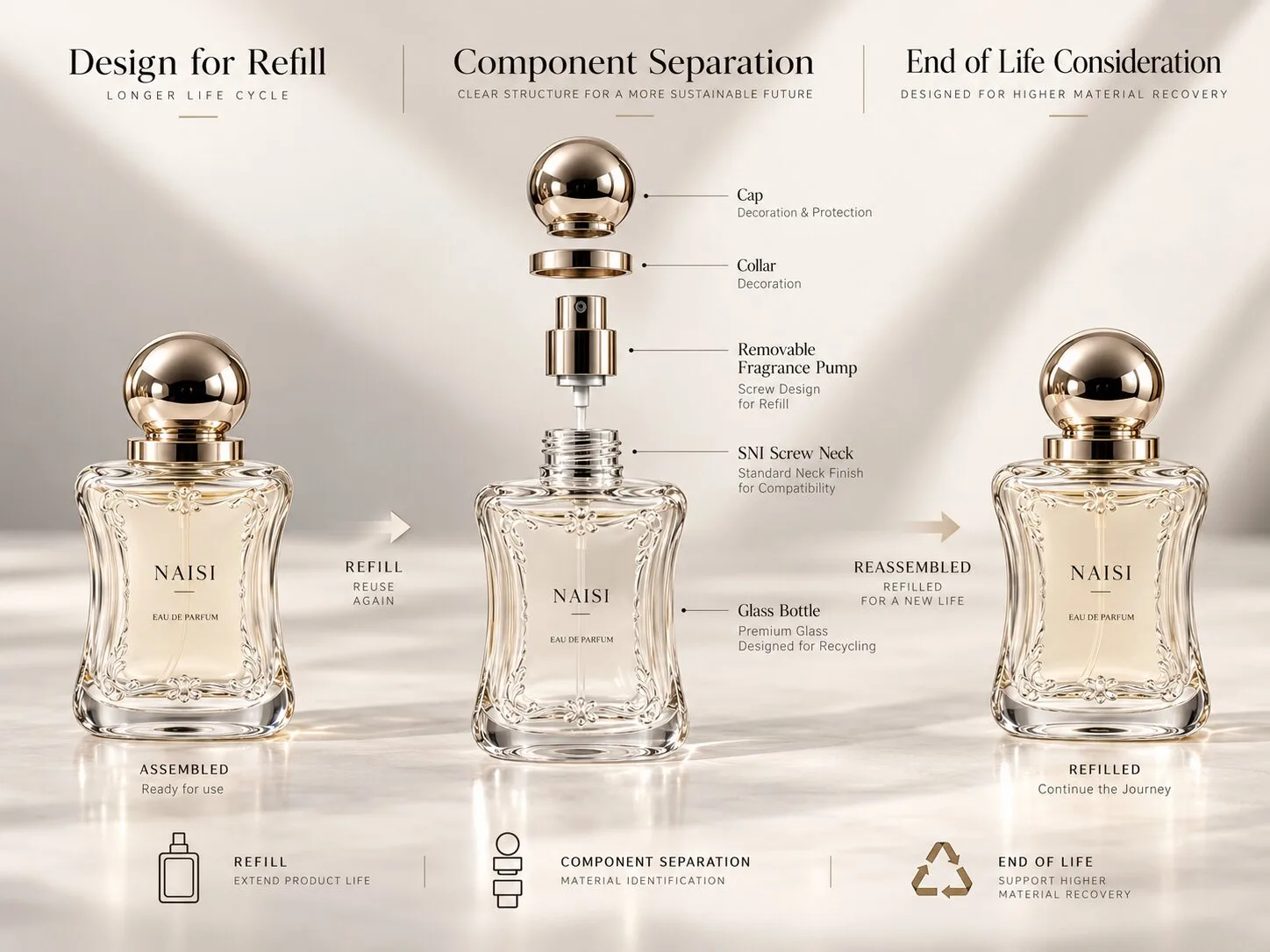
What should happen to the pump, ferrule, collar and cap when the package reaches end of life?
One route uses easier component separation.
Maison Violet provides a current example. In September 2026, Coverpla confirmed that the brand continued using Bormioli Luigi's lightweight ecoBottle in 50 ml and 100 ml formats. The bottle uses a screw neck for refilling and for easier separation of components for recycling.
Another route uses an integrated system designed around the recycling stream.
Aptar's Refill INUNE is designed to remain on the glass bottle at end of life and enter the glass recycling stream as a complete package, subject to the capabilities of the local recycler.
These examples show why fragrance packaging component separation should be evaluated according to the real component architecture and recycling route.
For brands selling in Europe, PPWR compliance should therefore be assessed on the final packaging configuration rather than on one feature such as a removable pump.
Practical Design Tips for Your Refillable Perfume Project
Start with the refill mechanism.
Decide how the consumer will refill the product before finalising the bottle.
A project based on a removable screw pump has different neck and sealing requirements from a system using a refill connector. This decision affects the glass neck, pump and filling process.
Next, confirm the actual neck finish.
For SNI projects, request the bottle neck drawing and pump specification from the relevant suppliers. Confirm the ferrule, collar and cap around that interface.
Then build assembled samples.
Test the refill gesture several times. Check how the dispensing assembly feels when opened and closed. Review sealing, spray performance and component alignment.
The formula should be included in functional testing because fragrance compatibility remains relevant even when the mechanical refill system works well.
Decoration comes after the functional structure is stable.
NAISI Packaging supports fragrance glass decoration including frosting, sandblasting, spray coating, silk screen printing and hot stamping. The decoration should be sampled on the final bottle, particularly around neck, shoulder and collar contact areas.
Stock and custom bottle routes can both support refill projects.
An established screw neck bottle can shorten the structural development stage. A custom glass bottle gives the brand greater control over proportions, base design and silhouette when volume and tooling plans support a proprietary package.
For procurement teams, the sampling checklist should cover the neck finish, pump fixation, refill method, sealing, spray performance, cap fit and intended end of life route.
That turns several individual components into one approved refillable fragrance packaging system.
FAQs (SEO boost)
Can crimp neck perfume bottles be refillable?
Traditional FEA crimp bottles use pumps mechanically secured to the glass neck and are generally designed for permanent assembly.
For full size fragrance bottles that need to be opened by the consumer, an SNI screw neck provides a more practical route because the compatible dispensing assembly can be removed and reattached.
Other refill architectures also exist, including connector based systems, so the correct solution depends on the intended refill method.
Does refillable packaging comply with EU PPWR?
Refillability can support PPWR objectives, while compliance depends on the complete package.
The PPWR has applied since 12 August 2026 and includes requirements covering recyclability, packaging minimisation and other packaging obligations. Reusable packaging has additional requirements under Article 11.
Brands should therefore evaluate their final fragrance package against the provisions relevant to that packaging format and market.
Can NAISI custom make refillable glass perfume bottles?
NAISI Packaging can support stock and custom glass perfume bottle projects using suitable screw neck structures and compatible fragrance components according to the project requirements.
Custom development can include bottle design, frosting, sandblasting, spray coating, silk screen printing and hot stamping.
Matching pumps, collars and caps can be coordinated around the selected neck finish, followed by sampling and functional evaluation before mass production.
Conclusion
A successful refillable fragrance packaging project starts with the refill architecture.
The neck finish creates the connection between the glass bottle and dispensing system. The pump determines how the fragrance is sprayed and how the package can be accessed again. The refill mechanism determines the consumer gesture, while the end of life design defines how the components should move into the appropriate recycling route.
These decisions work best when they are made together.
For fragrance brands, define the refill method first. Then select the compatible neck finish and pump, validate the assembled package and develop decoration around the approved structure.
NAISI Packaging supplies stock and custom glass perfume bottles and supports refill oriented fragrance projects with bottle development, screw neck component coordination and surface decoration.
If you are developing a new refillable fragrance line, share your target capacity, bottle concept, refill method, pump requirement and expected quantity with our team before sampling.
Which part of your refillable fragrance project is the most challenging today: neck finish, pump system, refill method or end of life design?